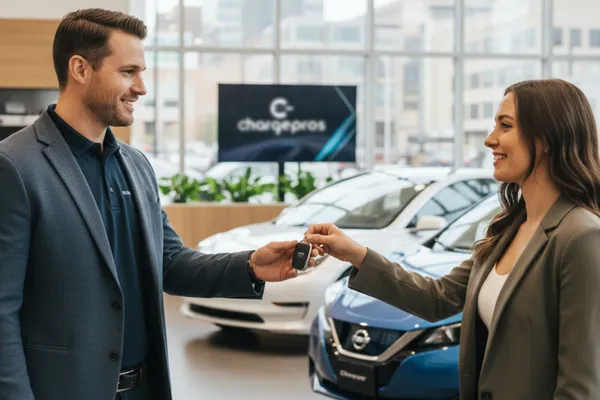
Buying a Used EV? Here is the Charger You Need First
The "Used EV Gold Rush" is officially here. With thousands of electric vehicles coming off-lease in 2026, many Florida drivers are finding incredible deals on pre-owned Teslas, Hyundais, and Fords.
However, there is a hidden "time tax" that many first-time used EV buyers discover the morning after they bring their new car home. Most used EVs are sold with a basic Level 1 charging cable—the kind that plugs into a standard 120V wall outlet. While "free," this basic cable is often the biggest bottleneck to enjoying your new ride.
The "40-Hour" Reality Check
A standard Level 1 charger adds roughly 3 to 4 miles of range per hour (Car and Driver, 2026). If you bought a used EV with a 75 kWh battery (like a Tesla Model 3 or a Hyundai IONIQ 5), charging it from empty to full on a standard wall outlet can take 40 to 70+ hours (Power-Sonic, 2026).
For the average Florida EV driver, a Level 1 cable barely replaces the energy used on a trip to the grocery store, let alone a daily drive to work.

Comparison chart of Level 1 vs Level 2 EV charging times for a 2026 used electric vehicle
The Smart Buyer's Checklist: What to Look for in a Used EV
Buying a used EV is different than buying a gas car. You don't check for oil leaks, you’re checking for data. Before you sign the papers, make sure you have these four items:
Battery Health Certificate: Many dealerships now offer a State of Health (SOH) report. A 90% SOH means the battery has retained 90% of its original capacity. Most modern batteries lose only about 1.5% to 2.3% per year, so a 3-year-old car should still be well above 90% (Geotab, 2026).
Charging History: Ask if the car was primarily "Home Charged" or "Fast Charged." According to a 2026 Geotab study of 22,000+ vehicles, EVs that rely heavily on high-power DC fast charging (over 100 kW) degrade roughly twice as fast as those charged primarily on Level 2 AC power at home (Geotab, 2026).
Software Updates: Ensure the firmware is current. In 2026, manufacturers frequently release "Over-the-Air" (OTA) updates that can actually improve range and charging speeds on older models.
Original Warranty Remaining: Federal law requires EV batteries to be warranted for at least 8 years or 100,000 miles, but some manufacturers offer even more. Ensure this is transferable to you (Endurance Warranty, 2025).

EV battery health diagnostic screen showing State of Health (SOH) percentage for a pre-owned electric car
Why Level 2 is the Real "First Step"
To truly unlock the value of a used EV, a Level 2 (240V) home charger isn't just an upgrade—it's a necessity.
Speed: A Level 2 station adds 25–35 miles of range per hour, meaning even the largest battery is topped off in just 6 to 9 hours (Treehouse, 2025).
Battery Longevity: As the Geotab data shows, slow and steady "gentle" charging at home on a Level 2 circuit is the best way to preserve your used battery's lifespan (Geotab, 2026).
Cost Savings: Public chargers in Florida often charge a premium. Charging at home allows you to take advantage of off-peak residential rates, which can be 50-70% cheaper than public fast-charging stations.
⚡ Make Your Used EV Feel Like New
At Chargepros, we specialize in helping used EV buyers get their garages ready before the car arrives. We don't just install a charger, we ensure your setup protects your "new-to-you" battery for years to come.
Ready to skip the 40-hour wait?
Consult with an Expert: Email your electrical panel photos to [email protected].
Get a Fast Quote: Take our 60-second home audit survey here.
Sources:
Car and Driver. (2026, January 26). EV Charging Levels Explained for New and Future Electric Vehicle Owners. https://www.caranddriver.com/features/a70141873/ev-charging-levels-explained/
Power-Sonic. (2026). How Long Does it Take to Charge an Electric Vehicle (EV)?. https://www.power-sonic.com/how-long-to-charge-an-ev/
Geotab. (2026, January 13). New Geotab data shows EV battery health remains strong as fast charging use increases. https://www.geotab.com/press-release/ev-battery-health-degradation-fast-charging-study/
Endurance Warranty. (2025, July 28). How to Check Battery Health in Used EV. https://www.endurancewarranty.com/learning-center/cost-price/buying-a-used-ev-how-to-check-battery-health/
Treehouse Resources. (2025, September 2). Level 1 vs. Level 2 EV Chargers: What Homeowners Need to Know. https://resources.treehouse.pro/post/level-1-vs-level-2-ev-charging
