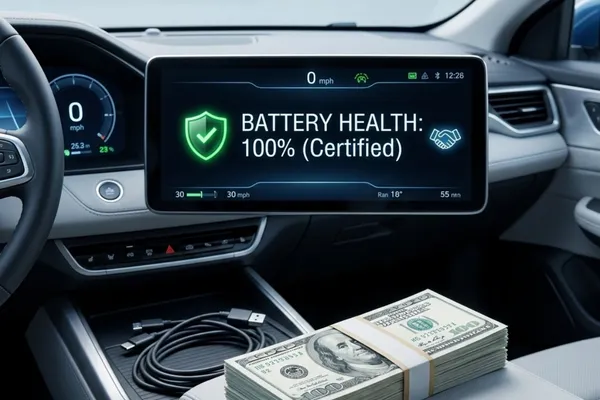
The EV Math: Are You Saving for a Rainy Day or a Battery Swap?
As we move into the heat of March 2026, Florida drivers are seeing a rare sight: a massive drop in home energy costs just as gas prices begin their seasonal climb. While Duke Energy customers are celebrating a $44/month rate decrease following the removal of 2024 storm charges (Duke Energy, 2026), gas drivers are bracing for the usual spring price hikes.
But even with cheap electricity, a shadow remains: The Battery Fear. "Sure, I’m saving $100 a month on gas now," you might think, "but am I just saving it up to pay for a $20,000 battery repair later?"
Let’s look at the real 2026 numbers—the savings, the safety nets, and the actual cost of a worst-case scenario.
The Baseline: Fuel vs. Electrons (Florida 2026)
To understand if an EV is worth it, you first have to see the daily profit you're making compared to a gas car.
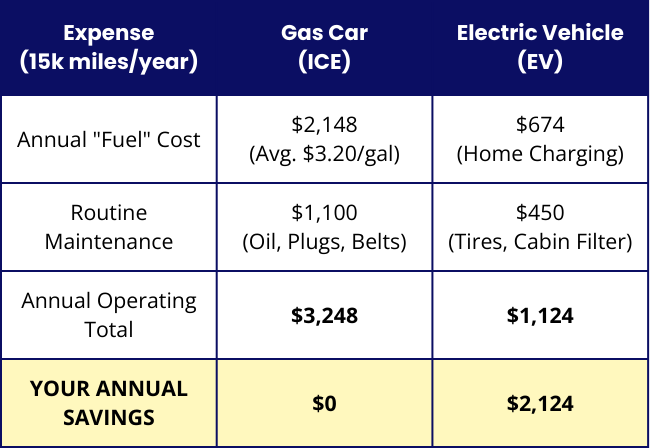
Annual Gas Costs ($2,148) vs Annual EV Charging Costs ($674) in Florida
In Florida, a typical EV driver is putting over $2,100 back in their pocket every single year (Coltura, 2026). Over a 10-year period, that’s $21,000 in savings—enough to buy a brand-new battery and still have cash left over.
Addressing the "Big Fear": Battery Repair & Replacement
If you’re worried about your battery dying at year nine, here is the state of the industry in 2026.
1. The 100,000-Mile Safety Net
While Florida doesn't have its own specific battery laws, you are protected by a strong federal baseline. Every new EV sold in the U.S. is legally required to have a battery warranty of at least 8 years or 100,000 miles (California Air Resources Board, 2022).
However, many 2026 model year vehicles are now built to meet even stricter "California-grade" standards to simplify national manufacturing. This means that even in Florida, many new EVs now carry a formal guarantee that the battery will not drop below 70% of its original capacity during the warranty period—with some brands like Rivian pushing coverage up to 175,000 miles (GreenCars, 2026).
2. Batteries are Outlasting the Cars
Data from 2024–2026 shows that modern EV batteries are far more durable than early skeptics predicted. Most packs are now expected to remain road-capable for 15 to 20 years (Recurrent, 2024).
3. The "Module" Revolution
In 2012, a single bad cell often meant you had to replace the whole $15,000 pack because the technology was less modular. By 2026, "module repair" has become a standard service. Instead of a full replacement, specialized shops can swap out specific failed modules for a fraction of the cost—typically $2,000 to $4,500 (Greentec Auto, 2025).
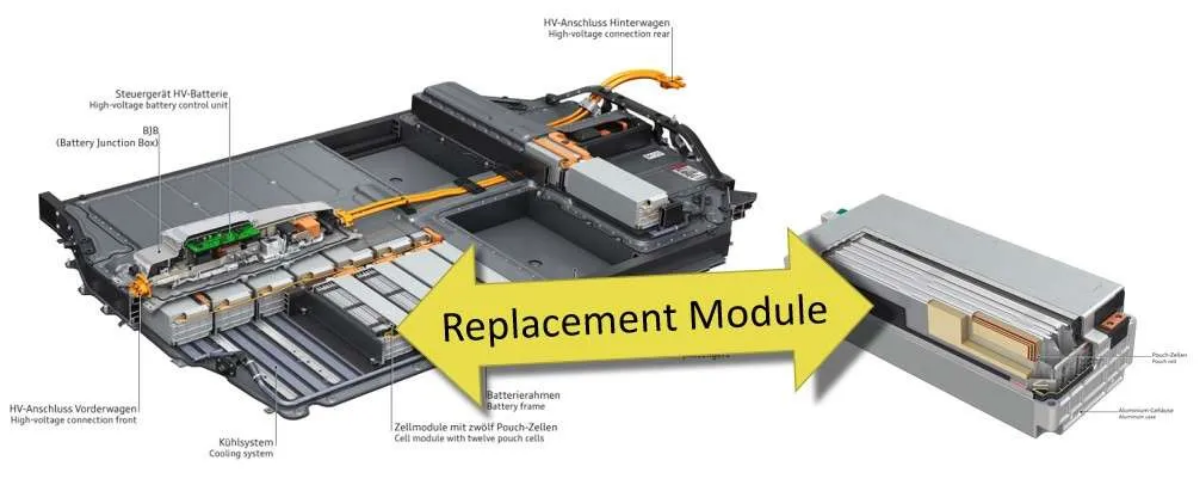
Replacement module for an EV battery that failed (Source: www.batterydesign.net)
4. What if you do need a full replacement?
If you are outside your warranty, battery prices have hit record lows. As of March 2026, the industry is seeing a significant shift in affordability. While actual costs can vary based on your specific vehicle and region, market analysts expect the average cost for a battery pack to settle around $105 per kWh this year (BloombergNEF, 2025).
To put that into perspective for your wallet:
Compact Models (e.g., Chevy Bolt, Nissan Leaf): An estimated $5,000 – $8,000.
Mainstream Models (e.g., Tesla Model 3, Hyundai Ioniq 5): An estimated $8,000 – $15,000 for a full pack.
The Reality Check: This price range is now comparable to the cost of a full engine and transmission replacement in a high-end gas vehicle (Recharged, 2025).
The Verdict: Is the Risk Real?
The battery fear is largely a relic of the past. When your Florida EV savings over 10 years ($21,000+) are double the cost of even the most expensive battery replacement (~$12,000), the math is clear: The risk is already paid for by your savings.
👉 Get a Quote for a Battery-Saving Smart Charger Install
Sources
Duke Energy. (2026, January 14). Duke Energy Florida announces significantly lower bills in 2026; residential customers using 1,000 kWh to see approximately $44 decrease beginning in March. https://news.duke-energy.com/releases/duke-energy-florida-announces-significantly-lower-bills-in-2026-residential-customers-using-1-000-kwh-to-see-approximately-44-decrease-beginning-in-march
Coltura. (2026). The electric vehicle vs gas calculator – See savings in 2026. https://coltura.org/ev-vs-gas-calculator/#calculator
California Air Resources Board. (2022). Section 1962.8, Title 13, California Code of Regulations: Warranty requirements for 2026 and subsequent model year zero-emission vehicles. https://ww2.arb.ca.gov/sites/default/files/barcu/regact/2022/accii/acciifro1962.8.pdf
GreenCars. (2026). Battery warranties and manufacturer protections. https://www.greencars.com/greencars-101/ev-battery-warranties-and-exclusions
Recurrent. (2024, April 18). Electric car battery replacement costs. https://www.recurrentauto.com/research/costs-ev-battery-replacement
Greentec Auto. (2025). Hybrid and EV battery replacement cost? https://greentecauto.com/how-much-does-it-cost-to-replace-a-hybrid-battery/
BloombergNEF. (2025, December 9). Bloomberg study claims battery prices will continue to fall at slower rate. https://www.electrive.com/2025/12/09/bloomberg-study-claims-battery-prices-will-continue-to-fall-at-slower-rate/
Recharged. (2025). EV battery replacement cost 2025: Complete price guide. https://recharged.com/articles/ev-battery-replacement-cost
🔍 Information Disclaimer:This post contains information sourced from third-party experts. While we strive to share the most current data, EV technology and regulations evolve rapidly. This content is for general informational purposes and does not constitute a technical endorsement by Chargepros.
⚠️ Safety Notice:Electrical installations should only be performed by licensed and insured professionals. Improper installation can lead to fire hazards or void your vehicle's warranty. Chargepros is a licensed electrical contractor—let us handle the power so you can enjoy the drive.
