The "80% Rule" Myth: When You Should Actually Charge to 100% (And Why it Matters for Your Battery)
If you have spent any time in EV forums or owner groups, you have likely heard the "80% Rule." The common wisdom says that if you want your battery to last, you should never charge past 80% for daily use.
But as we move through 2026, many Florida drivers are finding that this "rule" is more of a suggestion—and for some vehicles, following it strictly can actually do more harm than good. Understanding the chemistry under your floorboards is the key to maximizing both your range and your battery's lifespan in the Florida heat.
LFP vs. NMC: The Chemistry That Changes the Rules
The reason the 80% rule has become a "myth" is that it ignores the different types of batteries hitting the road today. Most EVs use one of two main chemistries: NMC (Nickel Manganese Cobalt) or LFP (Lithium Iron Phosphate).
If you drive a standard-range Tesla Model 3, a Model Y RWD, or certain Ford Mustang Mach-E models from 2024–2026, you likely have an LFP battery. Unlike their nickel-based counterparts, LFP batteries are significantly more tolerant of high states of charge. In fact, for these vehicles, charging to 100% isn't just "okay"—it's often recommended for daily use (InsideEVs, 2026).
On the other hand, if you drive a long-range or performance model, you likely have an NMC battery. These are more sensitive to "voltage stress" at the top end of their capacity. For these cars, sticking to the 80% or 90% limit for daily commuting remains the best practice to prevent accelerated degradation (Eleport, 2025).
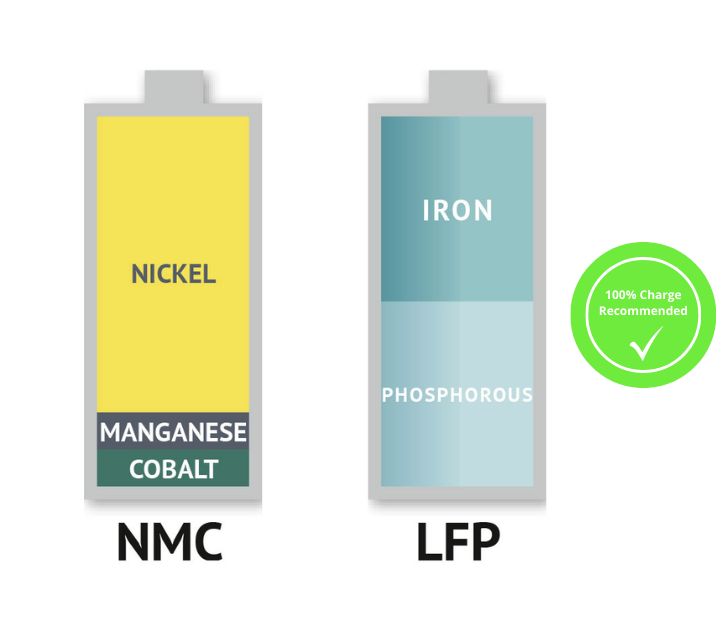
Components of an NMC battery vs. an LFP battery (Image source: TROES)
The Hidden Benefit: Why 100% is Essential for "Calibration"
Even if you have a battery that prefers the 80% limit, there is a technical reason to hit 100% occasionally: BMS Calibration and Cell Balancing.
Your car’s Battery Management System (BMS) is the computer that tells you exactly how many miles of range you have left. However, this computer can "drift" over time. Because the voltage curve of an LFP battery is extremely flat, the computer can lose track of where the "top" and "bottom" of the battery are (DriveProtected, 2024).
By charging to 100% at least once a week (for LFP) or once a month (for NMC), you allow the BMS to:
Re-center its range estimate: Ensuring you don't suddenly drop from 10% to 0% while on the highway.
Balance the cells: High-voltage charging allows the BMS to "top off" individual cells that might be lagging behind the others, ensuring the entire pack works in harmony (Recurrent, 2023).
The Florida Factor: Heat and High State of Charge
For Florida homeowners, there is one major caveat to the 100% rule: ambient temperature.
High heat accelerates chemical reactions inside a battery. If you charge an LFP battery to 100% and let it sit in a 95°F driveway for three days, you are exposing the cells to both voltage stress and thermal stress simultaneously. Studies have shown that while LFP is resilient, consistent exposure to 40°C (104°F) or higher can accelerate capacity fade (DriveProtected, 2024).
The 2026 Pro-Tip: If you need to charge to 100% for a road trip or calibration, time it so the car finishes charging right before you leave. This prevents the battery from "soaking" at a high voltage in the Florida sun (Imperevse, 2025).
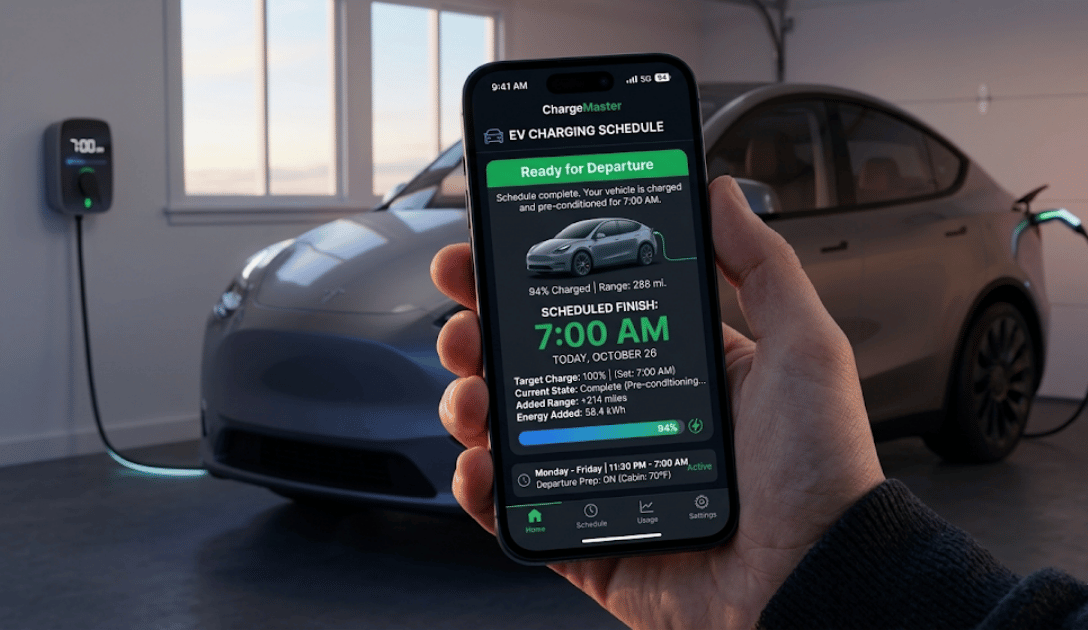
EV charging schedule mobile app setting 100 percent charge for morning departure (AI-generated)
The Verdict: Your Action Plan
Check Your Manual: If it says "LFP," set your limit to 100% and plug in regularly.
If you have NMC: Stick to 80% for daily errands, but don't be afraid to hit 100% before a long trip or once a month to keep your sensors accurate.
Beat the Heat: Always try to time your 100% charges so you drive the car shortly after they finish.
By understanding the "why" behind the numbers, you can stop worrying about the 80% myth and start getting the most out of your Florida EV experience.
Optimize Your Charging with Chargepros
The best way to manage the 80% vs. 100% balance is with a Smart Level 2 Home Charger. Whether you need to schedule a calibration charge to finish right before your morning commute or set a strict 80% limit for your NMC battery, our smart solutions put you in total control. Protect your battery and your investment with professional Florida installation.
👉 Get a Quote for a Smart Charger Install & Future-Proof Your Battery
Sources
InsideEVs. (2026, January 1). Why These Ford Mustang Mach-E And Tesla Batteries Should Be Charged To 100%. https://insideevs.com/news/783182/ford-tesla-lfp-battery-health/
Eleport. (2025, August 21). Should I Charge My EV to 100%? Here's How It Depends on the Battery You Have. https://eleport.com/should-i-charge-my-ev-to-100/
DriveProtected. (2024, September 18). Best Practices for Long-Lasting LFP Batteries in Your EV. https://driveprotected.com/blogs/blogs-and-helpful-articles/lfp-battery-maintenance-best-practices
Recurrent. (2023, March 7). Do I Need to Charge My Car to 100? https://www.recurrentauto.com/research/do-i-need-to-charge-my-car-to-100
Imperevse. (2025, October 30). How to Maximize Your EV's Battery Lifespan. https://www.imperevse.com/how-often-should-i-charge-my-ev-to-100-percent/
🔍 Information Disclaimer:This post contains information sourced from third-party experts. While we strive to share the most current data, EV technology and regulations evolve rapidly. This content is for general informational purposes and does not constitute a technical endorsement by Chargepros.
⚠️ Safety Notice:Electrical installations should only be performed by licensed and insured professionals. Improper installation can lead to fire hazards or void your vehicle's warranty. Chargepros is a licensed electrical contractor—let us handle the power so you can enjoy the drive.
