The "Silent Killer" of EV Range: Are Your Tires Costing You Money?
If you’ve noticed your electric vehicle isn't hitting the mileage numbers promised on the window sticker, you might be looking for a glitch in the software or a problem with the battery. But for most, the culprit is much simpler, hidden in plain sight, and currently bolted to your wheels.
In 2026, we’ve seen a massive influx of new owners moving from gas trucks and SUVs into high-torque EVs. The one thing nobody tells you at the dealership? Your tires are the single most important "car part" affecting your bottom line. Here is the no-nonsense breakdown of why EV-specific tires are the secret to protecting your range and your wallet.
1. Why Standard Tires Fail on an EV
You might be tempted to head to a big-box tire shop and grab the cheapest set of rubber that fits. Don't. Electric vehicles are fundamentally different from the internal combustion cars you’ve driven for the last 30 years. Because of the heavy battery pack, an EV weighs about 20% to 30% more than a gas car of the same size.
If you put standard tires on a 5,000-lb EV, the sidewalls will flex too much, creating heat and "rolling resistance." This is the range killer. According to Recharged (2025), using the wrong tires can drop your efficiency by 10% to 15% instantly. That’s like losing 30 miles of range just because you tried to save a few bucks on rubber.
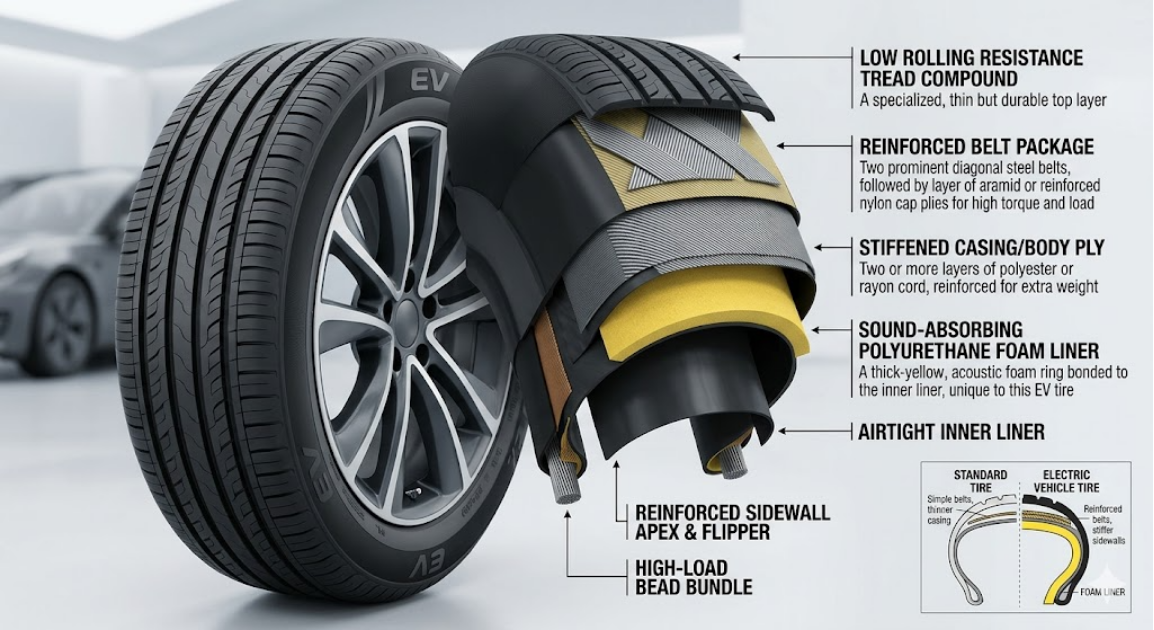
Components of an EV tire
2. The "Instant Torque" Problem
One of the best parts of driving an EV is the instant power. But that 0-60 speed comes at a cost. EVs deliver maximum torque the second you touch the pedal, which puts immense stress on the tire's contact patch.
In 2026, data shows that EV tires wear out 20% faster than gas car tires if they aren't specifically engineered with high-load compounds (Mandish, 2025). EV-specific tires use specialized rubber "recipes" designed to grip the road without shredding under the weight and power of an electric motor.
3. Noise: The Luxury Factor
Without an engine to drown out the road, tire noise becomes a major annoyance. Most top-rated EV tires in 2026 (like the Michelin Pilot Sport EV or Pirelli P Zero Elect) feature a "sound-absorbing" foam liner inside the tire.
Switching back to cheap, standard tires often results in a loud "hum" at highway speeds that can make your high-tech car feel like an old farm truck.
How to Save Money on EV Tires (The 2026 Checklist)
To get the best ROI on your rubber, follow these three rules:
Look for the "HL" Icon: In 2026, the new industry standard is the "High Load" (HL) rating. This confirms the tire can handle the extra weight of your battery without premature wear.
Prioritize Low Rolling Resistance: These tires are designed to "glide" further. They might cost 15% more upfront, but they pay for themselves in electricity savings over 20,000 miles.
Maintain Your PSI: Even the best tires fail if they are under-inflated. Check your pressure monthly—it’s the easiest way to prevent "range bleed."
Don't Cheap Out on the Connection
Your tires are the only thing connecting your car to the Florida pavement. Buying "cheap" tires for a high-performance EV is like putting budget 87-octane in a precision-engineered racing engine—it just doesn't work.
Ready to maximize your home charging efficiency too? At Chargepros, we help you optimize every part of your EV lifestyle. From high-speed Level 2 installs to energy audits, we ensure you’re getting the most out of every kilowatt.
👉 Email us today for a professional home charger consultation.
Sources
Recharged. (2025, November 18). Electric Vehicle Tuned Tires: range, comfort, and safety explained. Recharged. https://recharged.com/articles/electric-vehicle-tuned-tires?srsltid=AfmBOoqjN89P_czzSg9u_4fabc5iFt3Fl77sZC3kJDkxQjZ2xX1sYFbK
Mandish, D. (2025, August 11). Why do electric vehicle tires wear out so quickly? Sun Auto Tire & Service. https://www.sunautoservice.com/blog/why-do-electric-vehicle-tires-wear-out-so-quickly
🔍 Information Disclaimer:This post contains information sourced from third-party experts. While we strive to share the most current data, EV technology and regulations evolve rapidly. This content is for general informational purposes and does not constitute a technical endorsement by Chargepros.
⚠️ Safety Notice:Electrical installations should only be performed by licensed and insured professionals. Improper installation can lead to fire hazards or void your vehicle's warranty. Chargepros is a licensed electrical contractor—let us handle the power so you can enjoy the drive.
