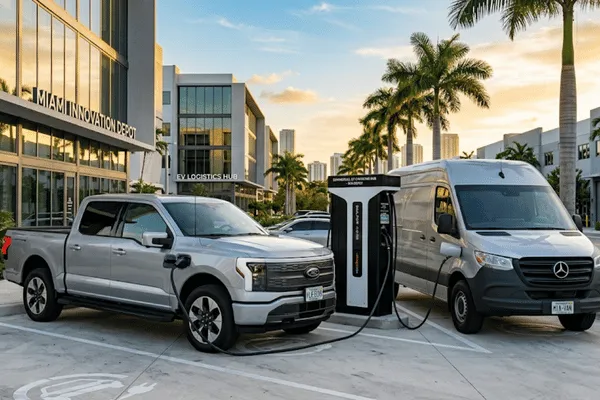
The 2026 Florida Business EV Guide: How to Stack "Free Money" Under the New Laws
Every business owner knows that the government usually has its hand in your pocket. But as of April 2026, the roles have reversed. Between the federal government’s push for fleet electrification and Florida’s utility companies competing for your load, there is a massive amount of "free money" on the table. If you are a business owner in Florida, you likely remember when the Section 179 deduction was a niche trick for heavy trucks; now, it is the cornerstone of a tax-advantaged EV strategy.
As a business owner, you have access to a significant range of federal tax credits, utility rebates, and manufacturer incentives that can drastically reduce the cost of transitioning to electric vehicles (EVs). Currently, the focus has shifted toward commercial fleet credits and infrastructure grants following recent federal legislative changes.
Here is how you can stack these incentives to potentially wipe out the entire cost of your next work vehicle and its charging station.
1. The Federal Heavy Hitters: Tax Credits and Deductions
The federal government has shifted its focus from simple "rebates" to accelerated depreciation. For high-earning businesses, this is actually a bigger win.
Section 179 & 100% Bonus Depreciation
If you are acquiring a heavy electric vehicle (GVWR over 6,000 lbs) in 2026—like the Ford F-150 Lightning or Silverado EV—you can no longer rely on the $7,500 or $40,000 credits unless you met the 2025 "binding contract" deadline.
Gross Vehicle Weight Rating (GVWR) isthe maximum total safe operating weight of a vehicle, as determined by the manufacturer. It includes the curb weight (empty vehicle) plus fuel, accessories, passengers, and cargo, but not trailers. Exceeding GVWR can lead to compromised handling, braking, and structural damage.
For vehicles purchased in 2026, the OBBBA has reinstated 100% Bonus Depreciation. This allows you to deduct the entire purchase price of a qualifying vehicle in the very first year (IRS, n.d.-a).
Commercial Clean Vehicle Credit (Section 45W)
Did you sign a contract for a fleet vehicle in late 2025 but it’s only arriving now?
If you entered into a binding written contract and made a nominal down payment on or before September 30, 2025, you can still claim the $40,000 Commercial Clean Vehicle Credit when that vehicle is "placed in service" (delivered) in 2026 (IRS, n.d.-b).
Alternative Fuel Infrastructure Credit (Section 30C)
Unlike the vehicle credits, the Alternative Fuel Infrastructure Credit (Section 30C) is still active for new projects, but its clock is ticking louder than ever.
Don’t just buy the truck—let Uncle Sam pay for the "gas station" in your warehouse. Section 30C provides up to a 30% credit for the cost of chargers and installation, capped at $100,000 per location. Note that the equipment must be placed in service by June 30, 2026, and the property must be located in an eligible non-urban or low-income census tract to qualify for the full amount (AFDC, n.d.).
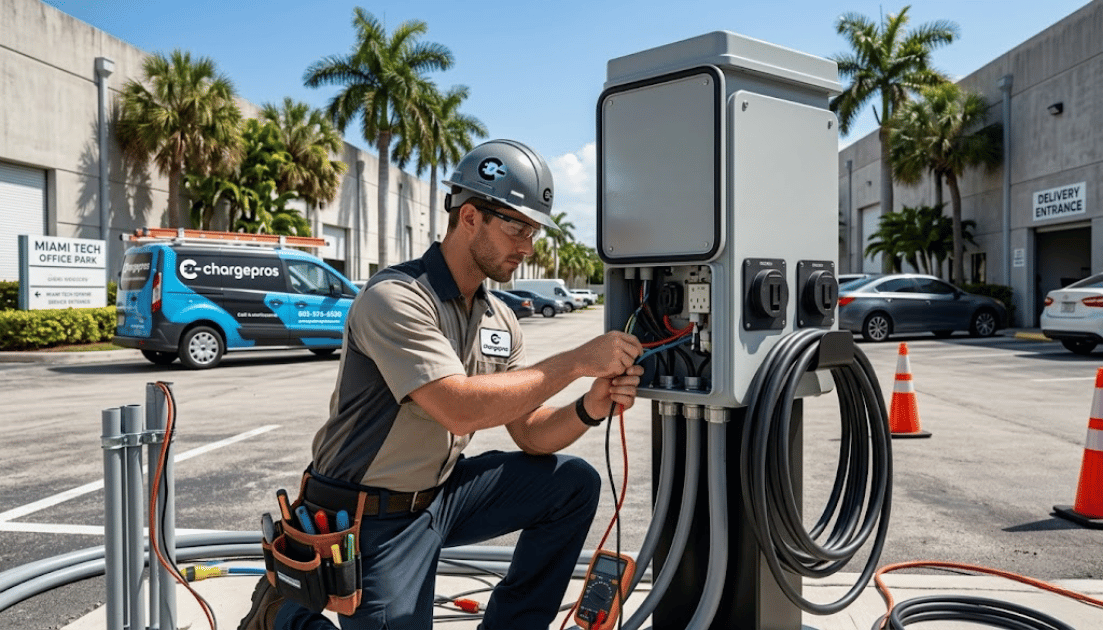
Acting before the June 30 deadline allows businesses to recoup up to 30% of their total installation costs
2. Florida Utility Support: Winning the Local Game
In Florida, your local utility provider is often your biggest ally in infrastructure. Most major Florida utilities offer rebates or technical support to help businesses with "make-ready" costs—the expensive behind-the-scenes work like wiring, transformers, and panels.
Florida Power & Light (FPL) "Make-Ready" Support
FPL offers a Commercial Infrastructure Support program, often covering up to $50,000 per port for the electrical infrastructure leading to your chargers (transformers, panels, and trenching). By utilizing this, FPL essentially pays for the trenching and electrical panels while you simply buy the charging hardware (FPL, n.d.).
Projects usually require a minimum of 2 ports. Maximum credits are reserved for DC Fast Chargers (250kW+), but Level 2 projects still qualify for thousands in "Make-Ready" coverage.
Duke Energy and Tampa Electric (TECO)
Duke Energy Florida provides substantial rebates for commercial customers: between $304 and $1,175 for Level 2 chargers, and a staggering $20,889 to $35,600 for DC Fast Chargers (QMerit, 2026).
Meanwhile, TECO frequently offers workplace and fleet charging rebates. However, these are budget-limited and require checking their Current Business Programs site for active windows (TECO, n.d.).
3. Manufacturer Incentives: The Private Sector "Conquest"
Car manufacturers are currently aggressive with "conquest" and "loyalty" cash to move EV inventory in Florida. These can often be stacked with your tax credits.
Ford: Offers roughly $5,500 in Loyalty Cash plus specialized commercial leasing deals for the F-150 Lightning and E-Transit (Ford Motor Company, 2026).
Mercedes-Benz: Provides up to $20,000 in consumer cash for eSprinter vans, perfect for last-mile delivery (Mercedes-Benz USA, 2026).
Kia/Hyundai: Offers up to $11,500 in customer cash on EV6/EV9 models to compete with domestic brands (Hyundai Motor America, 2026).
Jeep/Dodge: Has been seen offering $15,250 on select inventory for high-performance fleet vehicles (Stellantis, 2026).
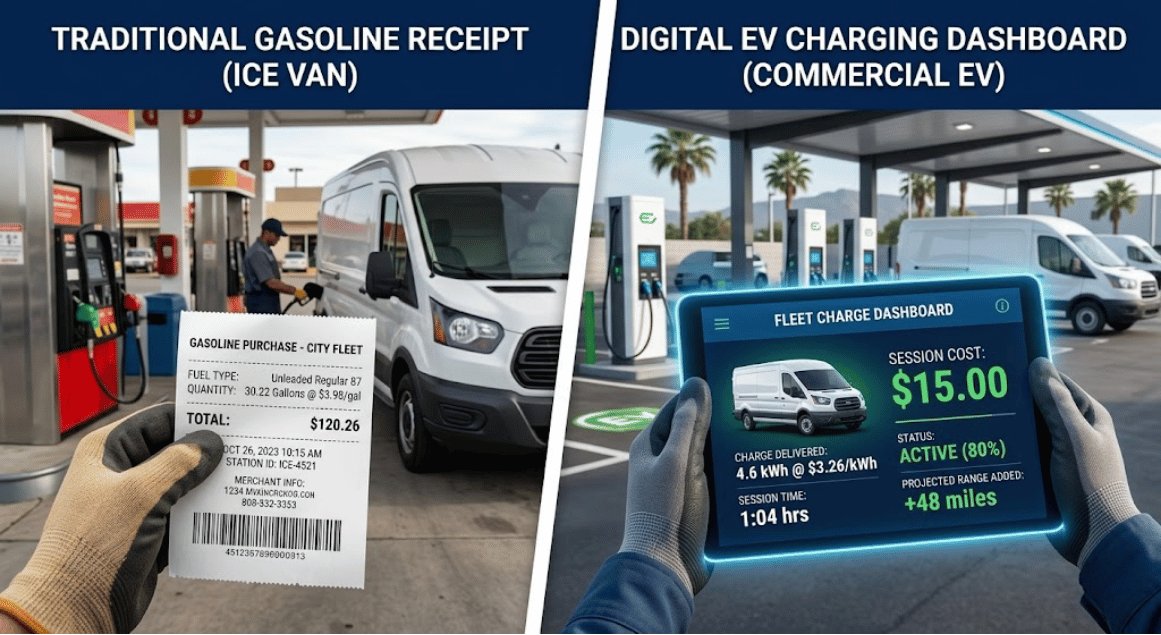
Slashing fuel costs is just the beginning; the real ROI comes from front-loading your tax deductions (AI-generated image)
Sources
Internal Revenue Service (n.d.). One, Big, Beautiful Bill provisions. https://www.irs.gov/newsroom/one-big-beautiful-bill-provisions
Internal Revenue Service (n.d.). Commercial Clean Vehicle Credit. https://www.irs.gov/credits-deductions/commercial-clean-vehicle-credit
Alternative Fuels Data Center (n.d.). Alternative Fuel Infrastructure Tax Credit. https://afdc.energy.gov/laws/10513
FPL (n.d.). FPL EVolution Make-Ready Credit program. https://www.fpl.com/electric-vehicles/for-business/make-ready-credit-program.html
Qmerit. (2026, March 20). Florida EV incentives, rebates and tax credits. Qmerit. https://qmerit.com/location/florida/
TECO (n.d.). Save Energy. https://www.tampaelectric.com/business/saveenergy/
🔍 Information Disclaimer: This post contains information sourced from third-party experts. While we strive to share the most current data, EV technology and regulations evolve rapidly. This content is for general informational purposes and does not constitute a technical endorsement by Chargepros.
⚠️ Safety Notice: Electrical installations should only be performed by licensed and insured professionals. Improper installation can lead to fire hazards or void your vehicle's warranty. Chargepros is a licensed electrical contractor—let us handle the power so you can enjoy the drive.
