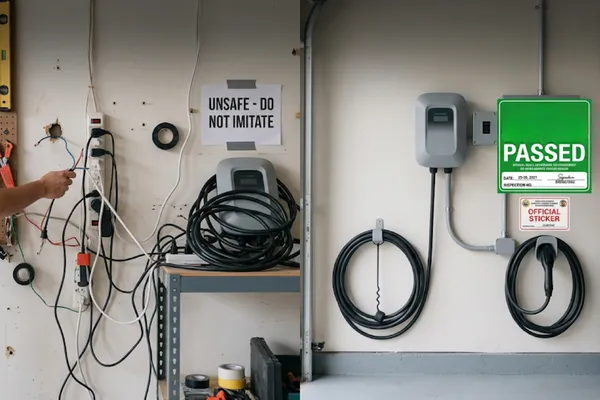
No Jokes: Why Professional EV Charging Installation is Your Home’s Most Serious Safety Upgrade
We’ve all seen the "hacks" on social media: a DIYer daisy-chaining three extension cords through a dryer vent or a "prank" video showing someone trying to charge their car using a hacked toaster oven. While these might get clicks, in the high-voltage world of 2026, they are recipes for disaster.
Installing an EV charger isn't like plugging in a new lamp; it’s more like adding a second air conditioner to your home that runs at full blast for eight hours straight. There is no room for "good enough." Professional installation is the only way to ensure your home remains a sanctuary rather than a fire risk.
1. Debunking the "DIY Plug-and-Play" Myth
A common misconception is that if you have a 240V outlet in your garage—like the one for your clothes dryer—you can just plug in a high-powered Level 2 charger and walk away.
The Reality: Most household outlets aren't designed for "continuous load." Charging an EV puts a constant, heavy strain on your wires for hours. Without a professional calculating your home’s load capacity, you risk melting your outlet, damaging your home's main panel, or worse, triggering thermal runaway—a self-sustaining battery fire that is nearly impossible to extinguish (Allianz Commercial, 2026).
2. The "Invisible" Danger: Heat and Arcing
Electricity generates heat. When you push 40 to 50 amps through a circuit that hasn't been professionally torqued and tested, micro-gaps can lead to electrical arcing.
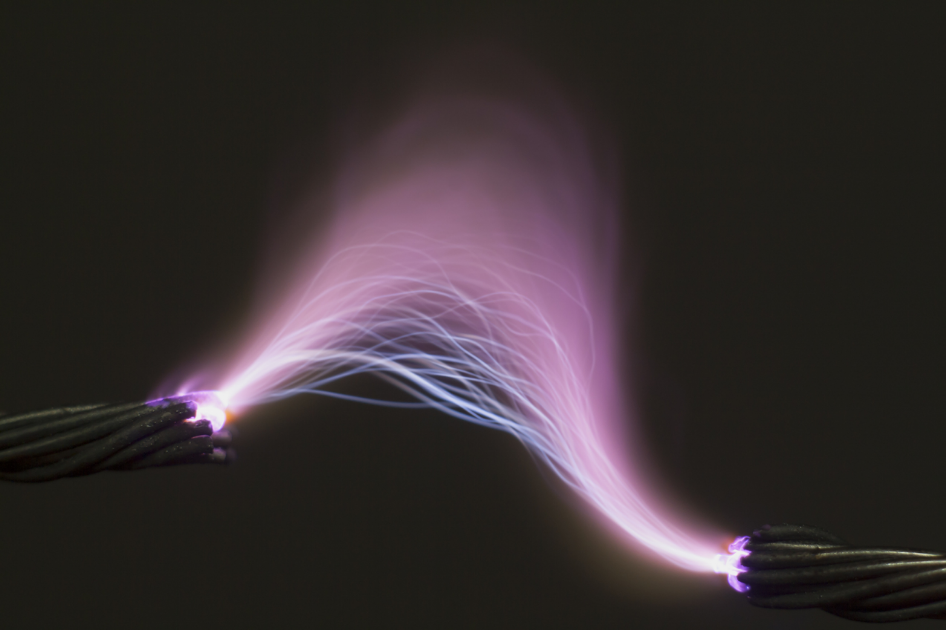
Electrical arcing is a dangerous, high-temperature discharge of electricity that jumps across an insulating gap (often air) between two conductors. It occurs when voltage breaks down air insulation, forming conductive plasma, often caused by damaged wiring, loose connections, or overloaded circuits, and poses severe fire and explosion risks.
Formation of plasma between two conductors (Image source: Clover Electric)
In 2026, building codes have become stricter because even a small malfunction can lead to catastrophic losses. Estimates suggest that 15% to 30% of EV-related fires are linked directly to faulty charging infrastructure (Allianz Commercial, 2026). A licensed electrician uses specialized tools to ensure every connection is "torque-spec" tight, preventing the heat buildup that leads to structural fires.
3. Permitting: Your Insurance Safety Net
Many homeowners try to skip the permitting process to save a few hundred dollars. This is a gamble where the house always wins.
The Risk: If a DIY or unpermitted installation causes a fire, your insurance company has a "get out of jail free" card. Most homeowner policies require that all major electrical work meet the National Electrical Code (NEC) and local building standards (Qmerit, 2026). If there’s no permit on file, they can—and often will—deny your claim, leaving you responsible for hundreds of thousands of dollars in damages (Qmerit, 2026).
The "No Jokes" Checklist for 2026
Before you plug in, ensure your installation ticks these three professional boxes:
Dedicated Circuit: Your charger must be on its own branch circuit to avoid overloading other appliances (NEC Article 625).
GFCI Protection: Modern standards now require Ground-Fault Circuit Interrupter protection for all cord-and-plug connected chargers to prevent lethal shocks (RectorSeal, 2025).
Surge Protection: In 2026, Surge Protection Devices (SPDs) are mandatory for new dwelling services to protect your car’s expensive computer from grid spikes (RectorSeal, 2025).
Don’t Gamble With Your Home
Your EV is likely the second most expensive thing you own, and your home is the first. Don't let a "social media hack" or a "cheap" unpermitted handyman put them both at risk.
At Chargepros, we don’t do "hacks." We provide permitted, code-compliant, and insurance-approved installations that let you sleep soundly while your car fuels up.
👉 Email us today for a professional, no-nonsense safety audit and installation quote.
Sources
Allianz Commercial. (2026). Fully charged: Plugged in to the risks of the EV revolution. https://commercial.allianz.com/news-and-insights/expert-risk-articles/risks-of-the-ev-evolution.html
Qmerit. (2026, March). Do I need a permit to install an EV charger in my home? https://qmerit.com/blog/do-i-need-a-permit-to-install-an-ev-charger-at-home/
RectorSeal. (2025, September 20). 2023 NEC code updates for EV charging | Key changes for electrical contractors. https://rectorseal.com/blog/2023-nec-code-updates
🔍 Information Disclaimer:This post contains information sourced from third-party experts. While we strive to share the most current data, EV technology and regulations evolve rapidly. This content is for general informational purposes and does not constitute a technical endorsement by Chargepros.
⚠️ Safety Notice:Electrical installations should only be performed by licensed and insured professionals. Improper installation can lead to fire hazards or void your vehicle's warranty. Chargepros is a licensed electrical contractor—let us handle the power so you can enjoy the drive.
